Smart Parenting and Financial Planning 2026: The most significant gift a parent can provide their daughter is not temporary luxury, but a secure and financially independent future. With rising education costs and wedding expenses, early planning is essential. Imagine having a corpus fund of ₹50 Lakhs to ₹70 Lakhs ready for her when she turns 21.
The Sukanya Samriddhi Yojana (SSY) is the flagship “Beti Bachao, Beti Padhao” initiative backed by the Government of India. In 2026, it continues to offer a compelling 8.2% Annual Interest Rate, which currently outperforms Public Provident Fund (PPF), Fixed Deposits (FD), and National Savings Certificates (NSC).
This detailed guide covers every aspect of the scheme, including calculations, tax benefits, withdrawal rules, and frequently asked questions.
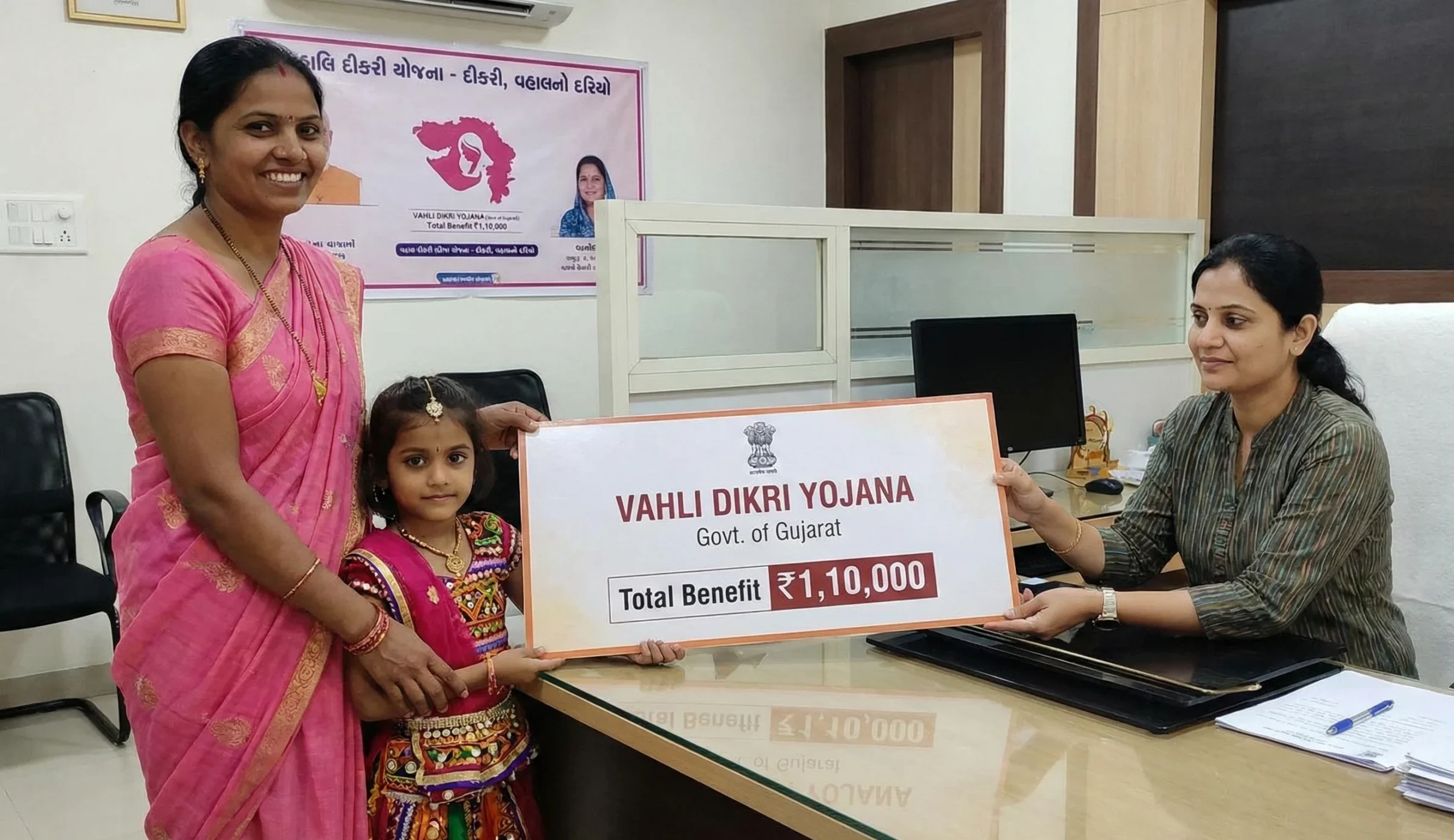
Comparison: Sukanya Samriddhi Yojana vs. Vahli Dikri Yojana
Parents often confuse state-level welfare schemes with central savings schemes. It is important to understand the fundamental differences to make an informed decision.
| Feature | Vahli Dikri Yojana | Sukanya Samriddhi Yojana (SSY) |
| Nature of Scheme | State Welfare Aid (Gujarat Govt) | Central Savings Scheme (Govt of India) |
| Funding | Government provides the money. | Parent deposits money; Govt provides high interest. |
| Income Limit | Only for families earning < ₹2 Lakh/year. | No Income Limit (Open to all). |
| Total Benefit | Fixed ₹1.10 Lakh total. | Depends on your savings (Can exceed ₹70 Lakhs). |
| Goal | Prevent female foeticide & dropouts. | Build a large corpus for higher education/marriage. |
SSY Scheme Highlights (Financial Year 2025-26)
The SSY account is a long-term investment tool designed to mature when the girl child is ready for higher studies or marriage.
- Interest Rate: 8.2% per annum (Calculated on the lowest balance between the 5th and the end of the month).
- Sovereign Guarantee: Being a central government scheme, the capital is 100% safe with zero market risk.
- Deposit Period: You must deposit money for the first 15 years from the date of account opening.
- Maturity Period: The account matures 21 years from the date of opening, or at the time of the girl’s marriage (whichever is earlier).
- Investment Limits:
- Minimum: ₹250 per financial year.
- Maximum: ₹1,50,000 per financial year.
Maturity Calculator: The Power of Compounding
The table below illustrates the potential maturity value if you start investing in 2026. Note: These figures assume the interest rate remains constant at 8.2% throughout the tenure, though rates are subject to quarterly revision by the Ministry of Finance.
| Monthly Contribution | Yearly Contribution | Total Amount Paid (15 Years) | Estimated Maturity Amount (21 Years) |
|---|---|---|---|
| ₹ 1,000 | ₹ 12,000 | ₹ 1,80,000 | ₹ 5,54,232 |
| ₹ 3,000 | ₹ 36,000 | ₹ 5,40,000 | ₹ 16,62,696 |
| ₹ 5,000 | ₹ 60,000 | ₹ 9,00,000 | ₹ 27,71,160 |
| ₹ 10,000 | ₹ 1,20,000 | ₹ 18,00,000 | ₹ 55,42,320 |
| ₹ 12,500 (Max Limit) | ₹ 1,50,000 | ₹ 22,50,000 | ₹ 69,27,900 |
Tax Benefits (EEE Status)
The Sukanya Samriddhi Yojana falls under the Exempt-Exempt-Exempt (EEE) category, making it one of the most tax-efficient investment options in India:
- Investment Exemption: The amount you deposit (up to ₹1.5 Lakh per year) is deductible from your taxable income under Section 80C of the Income Tax Act.
- Interest Exemption: The annual interest earned on the account is completely tax-free.
- Maturity Exemption: The final maturity amount you receive after 21 years is also fully tax-free.
Eligibility and Account Rules
To open an account, the following criteria must be met strictly:
- Girl Child Only: The beneficiary must be a girl child.
- Age Limit: The account can be opened anytime between the birth of the girl child and her 10th birthday.
- Citizenship: The girl child must be an Indian citizen resident in India. NRIs (Non-Resident Indians) are not eligible to open this account.
- Family Restriction: A parent or legal guardian can open an account for a maximum of two girl children.
- Exception: A third account is allowed only if the first birth resulted in a girl and the second birth resulted in twin girls, or if the first birth resulted in triplets. A medical certificate is required for proof.
Required Documents and Process
You can approach any Post Office or authorized commercial bank (SBI, HDFC, ICICI, Axis, etc.) to open the account.
- SSY Account Opening Form (Form-1): Available at the bank branch or Post Office.
- Birth Certificate: The birth certificate of the girl child is mandatory to verify her age.
- Identity Proof of Guardian: Aadhaar Card, PAN Card, or Passport of the parent/legal guardian.
- Address Proof of Guardian: Utility bill, Aadhaar, or Driving License.
- Photographs: Recent passport-sized photographs of both the parent and the girl child.
- Initial Deposit: Minimum ₹250 via Cash, Cheque, or Demand Draft.
Withdrawal and Premature Closure Rules
The lock-in period is the primary strength of this scheme, ensuring funds are not used for trivial expenses. However, the government allows withdrawals for specific major life events.
1. Withdrawal for Higher Education
Once the girl child attains the age of 18 years or has passed the 10th Standard (whichever is earlier), a partial withdrawal is permitted. You can withdraw up to 50% of the balance available at the end of the preceding financial year. This money must be used to pay admission fees or other educational expenses (proof of admission required).
2. Withdrawal for Marriage (Full Closure)
Premature closure is allowed for the purpose of the girl’s marriage, provided she has attained the age of 18 years. An application in Form-3 must be submitted along with a declaration on non-judicial stamp paper confirming the marriage.
Penalty for Default
If you fail to deposit the minimum amount of ₹250 in a financial year, the account will be considered in “Default.” To revive the account, you must pay a penalty of ₹50 per year of default, along with the minimum contribution amount for the missed years.
Frequently Asked Questions (FAQs)
Q1: Does the interest rate remain fixed for the entire 21 years?
Answer: No. The interest rate is not fixed for the entire tenure. It is reviewed and declared by the Ministry of Finance on a quarterly basis. However, once credited to your account, the interest is compounded annually.
Q2: Can I transfer my SSY account from a Post Office to a Bank?
Answer: Yes, the account is easily transferable anywhere in India. You can transfer it from a Post Office to a Bank, or from one bank branch to another. You will need to submit a transfer request and passbook at your existing branch.
Q3: What happens if the girl becomes an NRI (Non-Resident Indian) after opening the account?
Answer: If the girl child or the guardian becomes an NRI, the account can continue till maturity. However, the guardian must intimate the change of residential status to the bank/post office within one month.
Q4: Is it mandatory to close the account exactly after 21 years?
Answer: Yes. The account stops earning interest after the completion of 21 years from the opening date. It is advisable to withdraw the maturity amount promptly to invest it elsewhere.
Q5: Can I deposit money online?
Answer: Yes. If you open the account with a bank like SBI, HDFC, or ICICI, you can link it to your savings account and deposit money online via Net Banking or Standing Instructions (Auto-Debit).